Poverty, Racial Stress, and Child Development: A Wider Lens
Children do not experience poverty or racism as abstract social issues. These conditions can shape housing, schools, caregiver stress, safety, health, and opportunity—while relationships and community strengths remain protective.
In brief
In brief
Children do not experience poverty or racism as abstract social issues. These conditions can shape housing, schools, caregiver stress, safety, health, and opportunity—while relationships and community strengths remain protective.
What this article covers
- Poverty and racism operate through material, relational, institutional, and stress pathways.
- Disparities describe unequal conditions; they are not evidence of deficits in Black children or families.
- Racial discrimination is associated with poorer average youth mental-health outcomes.
- Supportive relationships matter, and families also need safer conditions and material resources.
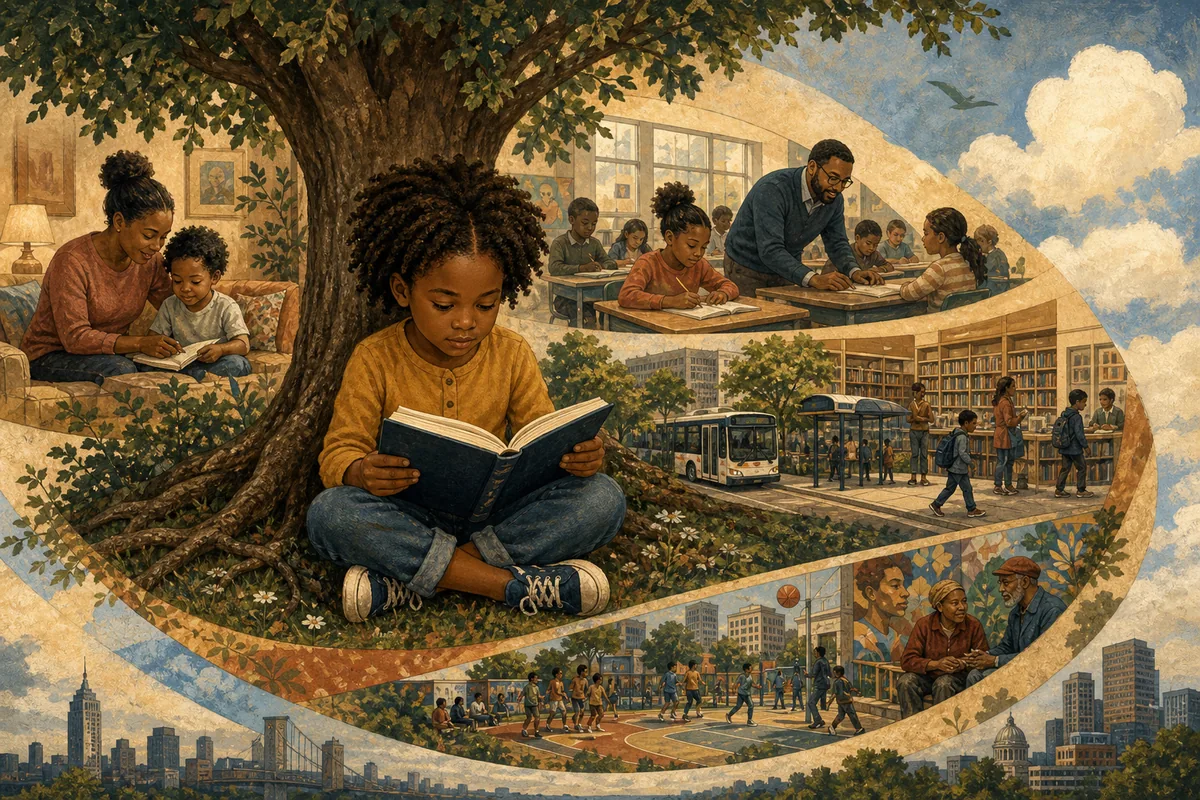
A child develops inside a real household and a real society. Rent, food, work schedules, transportation, school quality, neighborhood safety, healthcare, and discrimination can reach daily family life. None of those conditions tells us a child's worth or fixes an outcome in advance.
Poverty is a condition, not a parenting trait
Families with limited income make decisions under constraint. A caregiver may work unpredictable hours, move frequently, postpone care, or have little time to recover. These conditions can increase stress and reduce access to opportunities. They do not mean a family lacks love, knowledge, discipline, or aspiration.
Advice that focuses only on individual parenting can become another burden when the actual need is stable housing, food, healthcare, childcare, fair wages, or safety.
How racial stress enters development
Racial discrimination may be direct, such as unequal discipline or harassment, or vicarious, such as witnessing harm toward family and community. Structural racism also affects the distribution of resources and exposure to risk.
Longitudinal reviews associate racial discrimination during childhood and adolescence with later mental and physical health concerns. Associations vary, and research cannot predict one child's response. Cultural identity, family support, racial socialization, community connection, and protective adults can all matter.
Four connected pathways
- Material: housing, food, healthcare, transportation, learning resources, and safe places to play.
- Caregiver stress: pressure can reduce rest and emotional availability without reducing love.
- Institutions: schools, healthcare, policing, and employment can provide support or add threat.
- Meaning and identity: children interpret how they and their communities are represented and treated.
What protection looks like
Supportive relationships can help buffer stress, but protection should not become another demand that families compensate for unjust conditions alone. Useful responses operate at several levels:
- adults who listen, explain, and affirm a child's identity;
- schools with fair discipline, belonging, and access to support;
- community programs, mentors, faith communities, arts, and safe recreation;
- policies that strengthen family income, housing, healthcare, childcare, and work stability;
- direct action to reduce discrimination and institutional harm.
Ask a wider question
When a child struggles, ask not only “What skill does this child need?” Ask: “What has this child been carrying? Which settings make the problem better or worse? Who provides safety? What barrier can the adults or institution remove?”
Continue with Bronfenbrenner's ecological systems theory for a map of these connected settings. What We Didn't Get brings the same wider lens to unmet developmental needs in African American communities.
Research sources
- Systematic review: racial discrimination and child and adolescent health
- Harvard Center on the Developing Child: racism and early childhood development
- CDC: ACE risk and protective factors
Scope note: This article offers education and reflection, not a diagnosis or a substitute for individual medical or mental-health care. People with similar childhood experiences can have very different adult lives.
About this article
Reviewed July 26, 2026. This educational article does not diagnose or replace individual medical or mental-health care. Research links appear in the article where factual claims are discussed.
Read our editorial standards
Continue with Linda Kamal
Linda Kamal, RN, MSN-Ed, MA, is the founder of Shrewd Wit Inc. and author of What We Didn't Get, a trauma-informed exploration of unmet childhood needs, human development, and family healing.
Continue reading
Bronfenbrenner's Ecological Systems Theory: Child Development in Context
A child develops through relationships among home, school, work, neighborhood, culture, policy, and time. The model helps move attention from “fixing the child” to understanding connected environments.
Read articleErikson's Stages Through a Black Developmental Lens
Erikson's lifespan questions can support reflection on trust, autonomy, identity, intimacy, and contribution. They should not be treated as deadlines or used without cultural and structural context.
Read articleTrauma-Informed Education Without Turning Teachers Into Therapists
Trauma-informed schools create safety, predictability, connection, voice, and fair responses. Educators support learning and relationships; they do not diagnose trauma or ask students to disclose it.
Read article